
'Overtightening of monetary policy by central banks and the spread of new Covid variants, which may force governments to restart lockdowns or restrict mobility.'

Overall, volume growth is likely to be in the range of 3-8 per cent for two-wheelers and 5-7 per cent for passenger vehicles owing to healthy demand from urban and rural areas and pending order books.

Agriculture, pharma, electronics, and engineering goods together accounted for over 50 per cent of India's merchandise exports in 2024-25, according to government data, highlighting the country's growing strength in diverse sectors amid efforts to boost manufacturing and value-added exports.

Global oil prices have slumped and India has access to larger amounts of discounted Russian crude oil, yet refiners are not passing on their savings to consumers

International oil prices continue to be extremely volatile, falling on one day and rising thereafter, a top oil ministry official said explaining the reason behind no reduction in petrol and diesel prices despite softening in input cost, but could not say if the rates will be cut before Maharashtra elections. Global oil benchmark Brent crude futures fell below $70 per barrel last week -- the first time since December 2021 -- but gained thereafter. Brent was trading at $74.58 per barrel on Thursday while West Texas Intermediate advanced to trade at $71.71.

After oscillating over 486 points, the 30-share Sensex settled 38.44 points, or 0.10 per cent, lower at 39,020.39. It hit an intra-day low of 38,840.76 and a high of 39,327.15.

The Indian equity market valuation has been moving in tandem with the US 10-year treasury yield. While the benchmark US bond yield has witnessed a nearly 70 basis point decline since the end of October this year, dropping from 4.93 per cent to 4.23 per cent on Friday, the Sensex earnings yield has slipped by nearly 45 basis points - from 4.5 per cent to 4.05 per cent. Previously, Indian equities' earnings yields rose in sync with the US bond yields.

Titan Company on November 21, became the second Tata group firm to join Rs 3 trillion market capitalisation (market cap) club after its shares hit a new high of Rs 3,400, up nearly 2 per cent on the BSE in Tuesday's intra-day trade. At 12:28 PM; with a market cap of Rs 301,847 crore (Rs 3.02 trillion) Titan stood at number 16th position in overall market cap ranking on the BSE listed companies, the exchange data shows. Titan overtook paint company Asian Paints, which has a market cap of Rs 300,579 crore, data shows.
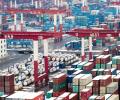
India's trade deficit with China neared $100 billion in FY25, amid escalating concerns of dumping, data released by the commerce department on Wednesday showed. Chinese imports rose by 11.5 per cent to $113.45 billion, while outbound shipments to the neighbouring country saw 14.5 per cent contraction to $14.2 billion.

'Investors should continue to invest because you are looking at the long-term; in the next four to five years, we are bound to outperform (the rest of the world equity markets).'

'Only if the Budget springs some surprises we may see a halt in the selling.'
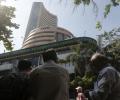
Rising for the fourth straight day, benchmark indices Sensex and Nifty settled marginally higher after a choppy session on Friday, tracking mixed global trends amid uncertainties on the geopolitical front. The BSE Sensex opened weak and declined 414.44 points to 55,049.95 in opening deals. But within minutes, it pared all its losses and jumped 369.56 points to 55,833.95. Facing volatility, the index finally settled at 55,550.30, higher by 85.91 points or 0.15 per cent.

Co-location attracts institutional investors, which drives volumes for long-dated options, with higher realisations at lower costs.

JSW Steel, owned by Sajjan Jindal, has emerged as the world's most valuable steelmaker, boasting a market capitalisation (mcap) of nearly $30.31 billion, according to Bloomberg data.

Equity benchmark indices Sensex and Nifty bounced back on Thursday to close higher by nearly 1 per cent on gains in banking, IT and auto shares amid mixed global trends. The 30-share BSE Sensex rose by 443.19 points or 0.86 per cent to settle at 52,265.72. During the day, it rallied 694.26 points or 1.33 per cent to 52,516.79. The NSE Nifty advanced 143.35 points or 0.93 per cent to 15,556.65.

Equity benchmarks Sensex and Nifty ended marginally lower on Tuesday as investors booked profits at higher levels amid a mixed trend in global markets.

The meltdown in Dalal Street that wiped out investor wealth to the tune of 44 trillion in 2025 also seems to be having a ripple effect on the country's vibrant automobile retail sales.

Equity benchmarks Sensex and Nifty halted their five-day rally on Tuesday and settled deep in the red, mirroring weak global markets, with decline in index heavyweights Reliance Industries, Infosys and HDFC Bank. Despite opening with gains of over 200 points, the 30-share Sensex turned highly volatile and tumbled 709.17 points or 1.26 per cent to close at 55,776.85. During the day, the benchmark index plunged 1,067.07 points or 1.88 per cent to 55,418.95. The broader NSE Nifty also declined 208.30 points or 1.23 per cent to close at 16,663.

The "weaponisation" of economic activity - through tariffs and sanctions - is now a reality, with countries leveraging these tools strategically, External Affairs Minister S Jaishankar said at the Raisina Dialogue recently.

ABB reported a weak quarter. Revenue was at Rs 2,910 crore, up only 5 per cent year-on-year (Y-o-Y), with operating profit at Rs 540 crore, up 23 per cent and net profit at Rs 440 crore.

'The biggest near-term risk to Indian equities is the outflow of investments to China as tactical trades by foreign investors.'

'The scrapping of import duty would help Indian companies compete in international markets, thus paving the way for India becoming a space manufacturing hub for the world.'

Indian frontline benchmarks - the S&P BSE Sensex and the Nifty50 - have rallied around 12 per cent each since June-end and outperformed their global peers by a wide margin. On Thursday, the US Fed hiked interest rates by another 75 basis points (bps) - the third such hike this year - and surprised the markets by projecting further sizable hikes in the coming months. With the latest hike, the Fed fund rate (FFR) now stands in the range of 3 - 3.25 per cent and is highest since January 2008.

The rising market poses a dilemma for investors on whether to continue buying, reduce equity holding, or exit equities altogether.

The chemicals sector's recovery could be delayed until FY25 if the current trends of weak demand and flat pricing continue. Following a subdued September quarter, the revenue and profit performance of listed chemicals companies are anticipated to fall short of initial expectations of an improvement. Despite some price stability, the demand trajectory remains uncertain.

Prime Minister Narendra Modi and US Vice President JD Vance have expressed satisfaction with the progress made in negotiations for a bilateral trade agreement. The two leaders met in New Delhi and discussed a range of bilateral issues, including cooperation in energy, defense, strategic technologies, and other areas. They also exchanged views on regional and global issues of mutual interest.
From the Sensex basket, Kotak Mahindra Bank jumped 5 per cent after the company reported a 25 per cent growth in its March quarter net profit at Rs 5,302 crore, limited by a drop in the core income due to narrow interest margins. Tata Consultancy Services, Hindustan Unilever, Mahindra & Mahindra, Sun Pharma, Tech Mahindra and IndusInd Bank were among the other major gainers. Titan tanked 7 per cent after its March quarter earnings failed to cheer investors.

India's e-commerce market alone is projected to reach $200 billion by 2026, making it a prime industry for ambitious entrepreneurs, explains rediffGURU Harsh Bharwani.

However, copious oil supplies amid growing global output and slowing Chinese oil consumption will put India in a better bargaining position with Gulf suppliers.

The ownership by domestic investors, individual as well as institutional, in companies listed on the National Stock Exchange (NSE) has breached the 25 per cent mark for the first time. The share stood at 25.72 per cent at the end of the March 2023 quarter, up from 24.44 per cent in the previous quarter, according to data from Prime Database. The share of foreign portfolio investors (FPIs), meanwhile, rose slightly to 20.56 per cent from 20.24 per cent as on December 31, 2022.

'Along with Blackstone, we would be keen to look at opportunities in the North.'

Bharti Airtel was the top laggard in the Sensex pack, shedding over 2 per cent, followed by Sun Pharma, ITC, SBI, Axis Bank, HDFC twins and Nestle India.

'API prices are dragging down margins and impacting our competitive ability.'

India needs another shot of difficult reform, of the kind only possible at gunpoint. Mr Trump holds that gun to our heads now. A drastic reduction in tariff protection, other elements of sarkari wet-nursing will force entrepreneurial India to become competitive again, argues Shekhar Gupta.

Investors' wealth fell by Rs 2.39 lakh crore on Monday in line with a weak trend in the global equity markets. The BSE Sensex tanked 861.25 points or 1.46 per cent to settle at 57,972.62. During the day, it tumbled 1,466.4 points or 2.49 per cent to 57,367.47.

'What's sad today is that there are so many people who cannot find work, not because the country is devoid of that opportunity, but because we are not doing enough in the country.'

Rising penetration of trade generic medicines is eating into the value growth of the domestic pharmaceutical market, showed a recent analysis. According to a Kotak Institutional Equities analysis, 70-110 basis points (bps) annual dent is expected from trade generics and Jan Aushadhi on Indian Pharma Market (IPM) growth at least until FY27-28 (see chart). Trade generic medicines are those that are not pushed into the market through doctor promotions.

Union Minister of Commerce and Industry Piyush Goyal's recent comments on large e-commerce players have reignited the debate about their impact on smaller offline retailers. On Wednesday, Goyal said that the rapid growth of e-commerce in India is a "cause for concern" and is diminishing the market share of small, mom-and-pop stores by offering high-margin products such as consumer electronics and apparel at discounted rates.

Dabur's performance in the July-September quarter of the current financial year (Q2FY25) was weak but in line with consensus. Consolidated revenue declined 5 per cent year-on-year (Y-o-Y) due to a temporary adjustment in General Trade (GT) inventory. Indian revenue declined 7.6 per cent, while international business grew 13 per cent Y-o-Y in constant currency (CC) terms.

The Indian pharmaceutical market (IPM) grew 6.8 per cent to touch a turnover of ~1.93 trillion in calendar year 2023, despite volumes going down marginally by 0.9 per cent. This indicates the price increase has been the major growth driver. Growth in the moving annual turnover (the previous 12 months' turnover) in December was 5.1 per cent and that in new product introduction 2.6 per cent, while volumes dipped 0.9 per cent, leading to an overall growth rate of 6.8 per cent, according to the data from market research firm Pharmatrac.
